Clinical research at TMDF
Accelerating discovery,
from Knoxville to the world.
Local impact, global reach. Some of the most advanced dementia research in the world is happening right here in Knoxville. TMDF works alongside leading research sponsors and national networks to bring the newest diagnostic technology and investigational treatments to East Tennessee, so patients here help shape the future of dementia care and bring new hope for better treatments and, one day, a cure.
Explore current research and our study history. Our team can explain what a study involves and help you understand whether screening may be appropriate.
5 current studies & networks11 historical records
Why research at TMDF
World-class research,
right here at home.
Families in East Tennessee don’t have to travel far to reach the leading edge of dementia research. It’s happening here.
Global science in Knoxville
We take part in studies with some of the world’s leading research sponsors and national networks, including Roche, Eli Lilly, Eisai, and the Alzheimer’s Network for Treatment and Diagnostics (ALZ-NET).
Led by a nationally recognized expert
Dr. Monica Crane has served as principal investigator for 16 clinical and research trials, bringing the latest diagnostics and treatments to patients in our region.
On the international stage
Our research team presents its work at the international Clinical Trials on Alzheimer’s Disease (CTAD) conference, sharing what we learn here with researchers around the world.
Current studies & networks
Explore current research.
“Active” describes a study’s ongoing activity and does not guarantee that new participants are being accepted. Confirm current opportunities with our team.
Featured study · Real-world evidence
LEADER
Lecanemab in Early Alzheimer’s Disease: A Comprehensive Multicenter Retrospective Real-World Study
LEADER evaluates how lecanemab (LEQEMBI) is used in routine U.S. clinical practice, examining treatment pathways, clinical outcomes, safety, and healthcare provider experiences in people with early Alzheimer’s disease.
Study design
A multicenter, retrospective observational study using deidentified patient medical records, healthcare provider surveys, and interviews across U.S. neurology practices.
Who may be represented
People with early Alzheimer’s disease who received at least seven lecanemab infusions as part of routine clinical care and whose medical records met the study’s inclusion criteria.
What to know
LEADER examines existing clinical-care data. It is not an interventional trial recruiting patients to receive an investigational treatment.
Interim results
Interim results from the LEADER study were presented at the Alzheimer’s Association International Conference (AAIC) in July 2026 (Eisai news release, opens in a new tab).
The analysis included 432 patients with early Alzheimer’s disease treated with lecanemab across 13 U.S. sites. Among 427 patients whose disease stage could be evaluated, 82.5% remained in the same disease stage (75.9%) or improved to an earlier stage (6.6%) over an average treatment duration of approximately 17 months.
Eisai and Biogen reported safety observations consistent with U.S. FDA-approved labeling, including amyloid-related imaging abnormalities (ARIA) in 12.3% of patients.
Read the published study (opens in a new tab) or Eisai’s October 2026 update (opens in a new tab).
Phase 3
TRONTIER 1
A study assessing the efficacy and safety of trontinemab in people with early symptomatic Alzheimer’s disease, from mild cognitive impairment through mild dementia.
Study design
An 18-month, double-blind, placebo-controlled study that randomly assigns participants 1:1 to trontinemab or placebo.
Who may qualify
Adults ages 50–90 with eligible early symptomatic Alzheimer’s disease, amyloid confirmation, and a reliable study partner.
Treatment & diagnostics network
ALZ-NET
The Alzheimer’s Network for Treatment and Diagnostics supports the collection of real-world evidence about newly approved Alzheimer’s treatments and diagnostic technologies.
Sponsored by
Alzheimer’s Association
Managed by
American College of Radiology
Phase 3
POLARIS-AD
A study evaluating the efficacy and safety of AR1001 for people with early Alzheimer’s disease.
Study design
A double-blind, randomized, placebo-controlled, multicenter, parallel-group study.
Who may qualify
Adults ages 55–90 with eligible mild cognitive impairment or mild dementia, positive amyloid biomarkers, and a study partner.
Phase 3
TRAILRUNNER-ALZ 3 (LAKI)
A study evaluating whether remternetug delays the onset or worsening of memory, thinking, or daily-functioning problems in early Alzheimer’s disease.
Study design
A randomized, double-blind, placebo-controlled, parallel-group study with screening, treatment, observation, and a possible open-label extension.
Who may qualify
Adults with eligible early Alzheimer’s disease, including amyloid confirmation and other health requirements.
Historical studies
Part of our research history.
These studies are no longer enrolling at TMDF. A registry’s overall study status may differ from availability at our clinic.
Novo Nordisk NN6535-4725 (EVOKE-Plus) — Oral Semaglutide in Early Alzheimer’s (Phase 3)
DiscontinuedNovo Nordisk ended further investigation for this indication after the EVOKE and EVOKE-Plus trials did not show a statistically significant slowing of disease progression compared with placebo.
View study recordBrainshuttle AD — RO7126209 in Alzheimer’s Disease (Phase 1b/2a)
Archived at TMDFRandomized, double-blind, placebo-controlled study evaluating the safety, tolerability, pharmacokinetics, and pharmacodynamics of RO7126209 in prodromal or mild to moderate Alzheimer’s disease.
View study recordTRAVELLER — Alzheimer’s Study Prescreening (Phase 3)
Archived at TMDFGlobal master prescreening study that used a cognitive test and plasma pTau217 levels to assess potential eligibility for Roche Alzheimer’s disease trials. No investigational medicine was administered.
View study recordAcadia ACP-103-046
CompletedPhase 3 pimavanserin safety study in adults with neuropsychiatric symptoms related to neurodegenerative disease.
View study recordAcadia ACP-103-047
CompletedPhase 3, 52-week open-label extension evaluating the long-term safety and tolerability of pimavanserin.
View study recordNovo Nordisk NN6535-4730 (EVOKE)
CompletedPhase 3 study of once-daily oral semaglutide in people with early Alzheimer’s disease.
View study recordBiogen ENVISION (221AD305)
TerminatedPhase 3 study designed to verify the clinical benefit of aducanumab in early Alzheimer’s disease.
View study recordBiogen ICARE-AD
TerminatedProspective real-world observational study of aducanumab-avwa use in U.S. clinical practice.
View study recordAFTD – FORWARD
CompletedOne-year observational study of cognitive, behavioral, and functional change in behavioral-variant frontotemporal dementia.
View study recordAmylyx – AMX0035 (PEGASUS)
CompletedPhase 2 randomized, double-blind study of AMX0035 in mild cognitive impairment or early dementia due to Alzheimer’s disease.
View study recordBiogen – BIIB092 (Gosuranemab)
TerminatedPhase 2 study evaluating the safety, tolerability, and efficacy of gosuranemab in early Alzheimer’s disease.
View study record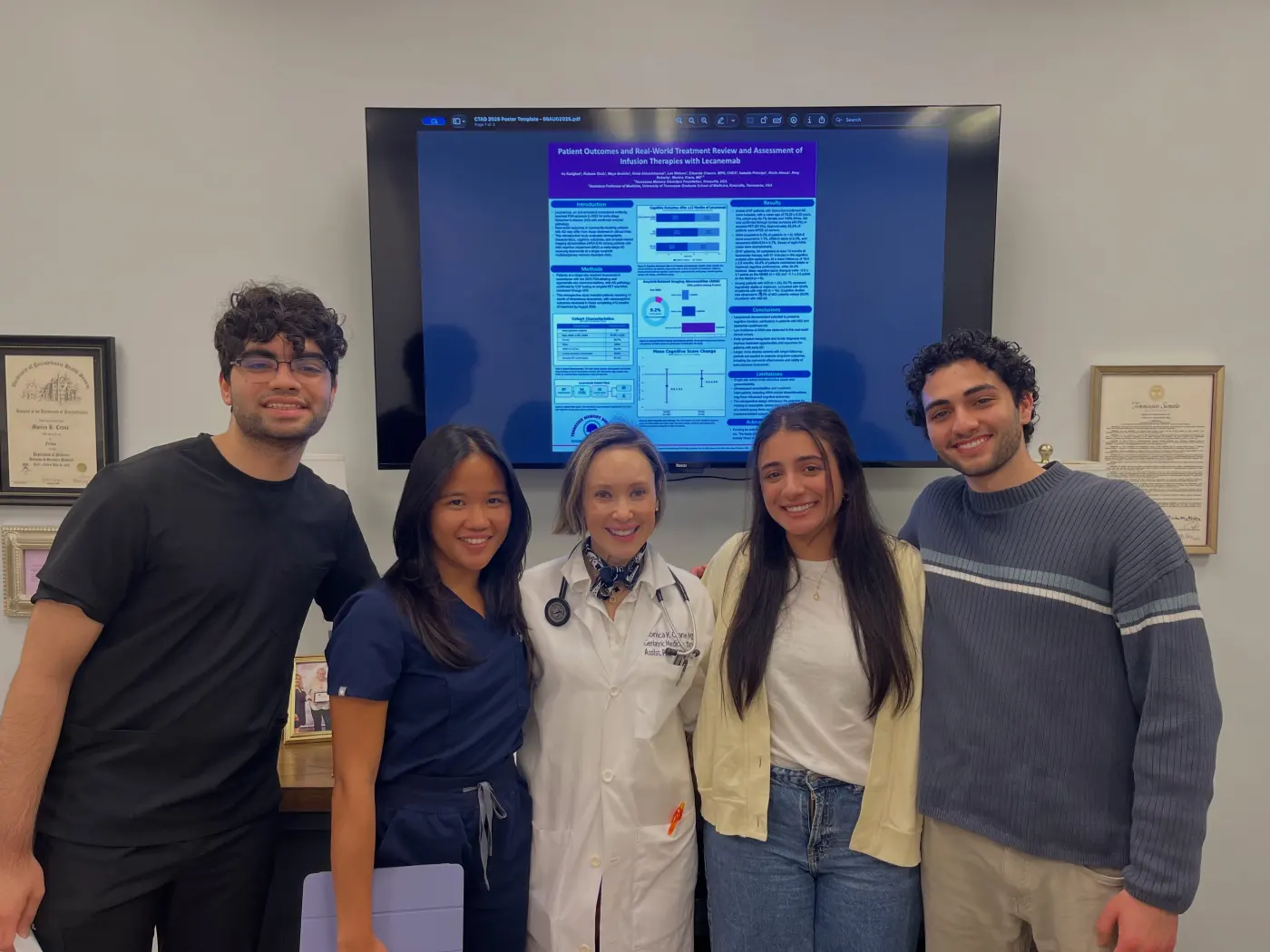
Our research team
From our clinic to the CTAD conference.
Our student research team presented their clinical trial research to Dr. Monica Crane before traveling to Boston to present it at the Clinical Trials on Alzheimer’s Disease (CTAD) conference.
Our clinical research coordinators and interns work alongside Dr. Crane, the principal investigator on our current studies.
Support our research
Passionate about advancing
dementia research?
Help keep East Tennessee at the forefront of dementia research. Gifts to the Tennessee Memory Disorders Foundation support our work in research, care, and the mentorship of future dementia-care professionals.
Find a study
Looking for other studies?
TMDF takes part in a select number of studies at a time. To search Alzheimer’s and dementia studies across the country, use these free resources from the National Institutes of Health (NIH).
If you find a study you’re interested in, we’re happy to talk it through with you.
A conversation is the first step
Curious about
participation?
Call our clinic or send the research team a message to ask about a study. If appropriate, the research team can explain pre-screening, study visits, eligibility, and informed consent.
Participation is voluntary.
Study eligibility is determined by the full protocol and screening process. Research may involve risks, and participation does not guarantee benefit.
Study eligibility is determined by the full protocol and screening process. Research may involve risks, and participation does not guarantee benefit.
Our research location
Tennessee Memory Disorders Foundation & Clinic
1400 Dowell Springs Boulevard · Upper Entrance · Suite 340
Knoxville, Tennessee 37909
Tennessee Memory Disorders Foundation & Clinic
1400 Dowell Springs Boulevard · Upper Entrance · Suite 340
Knoxville, Tennessee 37909
For a medical emergency, call 911. Do not submit sensitive medical information through ordinary website forms or email.